AI relighting for indie filmmakers: Interview with Joshua M Kerr
"A tool must solve a real problem in the storytelling process and be accessible."

Joshua M Kerr Transforms Indie Films with Beeble's SwitchLight 2.0
Filmmaker and YouTuber Joshua M Kerr began experimenting with film at just nine years old, making Wallace and Gromit-style clay animations in his living room back in the '90s. That early passion never left him.
What drives Kerr today is the same instinct that motivated him then: the desire to make things easily and freely from home, without needing big budgets or large crews. Through his YouTube channel, he now shares that approach with others, teaching creators how to produce impressive, cinematic results in their own spaces, without breaking the bank.
In this interview, Kerr discusses his journey into virtual production, his discovery of Beeble, and how a 24-hour challenge using SwitchLight 2.0 demonstrated just how far AI relighting has come.
Background
What sparked your interest in virtual production and filmmaking?
I've been making things since I was nine, starting with stop-motion clay animations in my living room. Eventually, I went on to study TV and broadcast production at university. A few years ago, I discovered virtual production — the idea of using tools like Unreal Engine to create environments and integrate real-world performances. I started sharing that process on YouTube. The more I explored, the more my audience responded. It felt like the perfect way to show people that they could tell bigger stories without needing massive resources.
Your YouTube content has attracted a wide audience. Who are you creating for?
It's a broad mix. There are complete beginners who have never touched Unreal or virtual production, as well as industry professionals who watch along. Even if you're on a big LED wall shoot, you don't necessarily have access to that tech for your own projects.
Many of us want to create things ourselves and tell our own stories. My channel is about learning as I go and inviting people to follow the process, including the mistakes.
Choosing Tools
How do you decide which tools to feature in your videos?
I'm very picky. A tool must solve a real problem in the storytelling process and be accessible. A lot of virtual production gear is expensive, so there's no point covering something my audience can't use.
How did you approach finding tools that could actually work for your process?
I'd been searching for ways to do relighting for more than a year before Beeble even existed. I tested other tools, but they weren't good enough to use seriously.
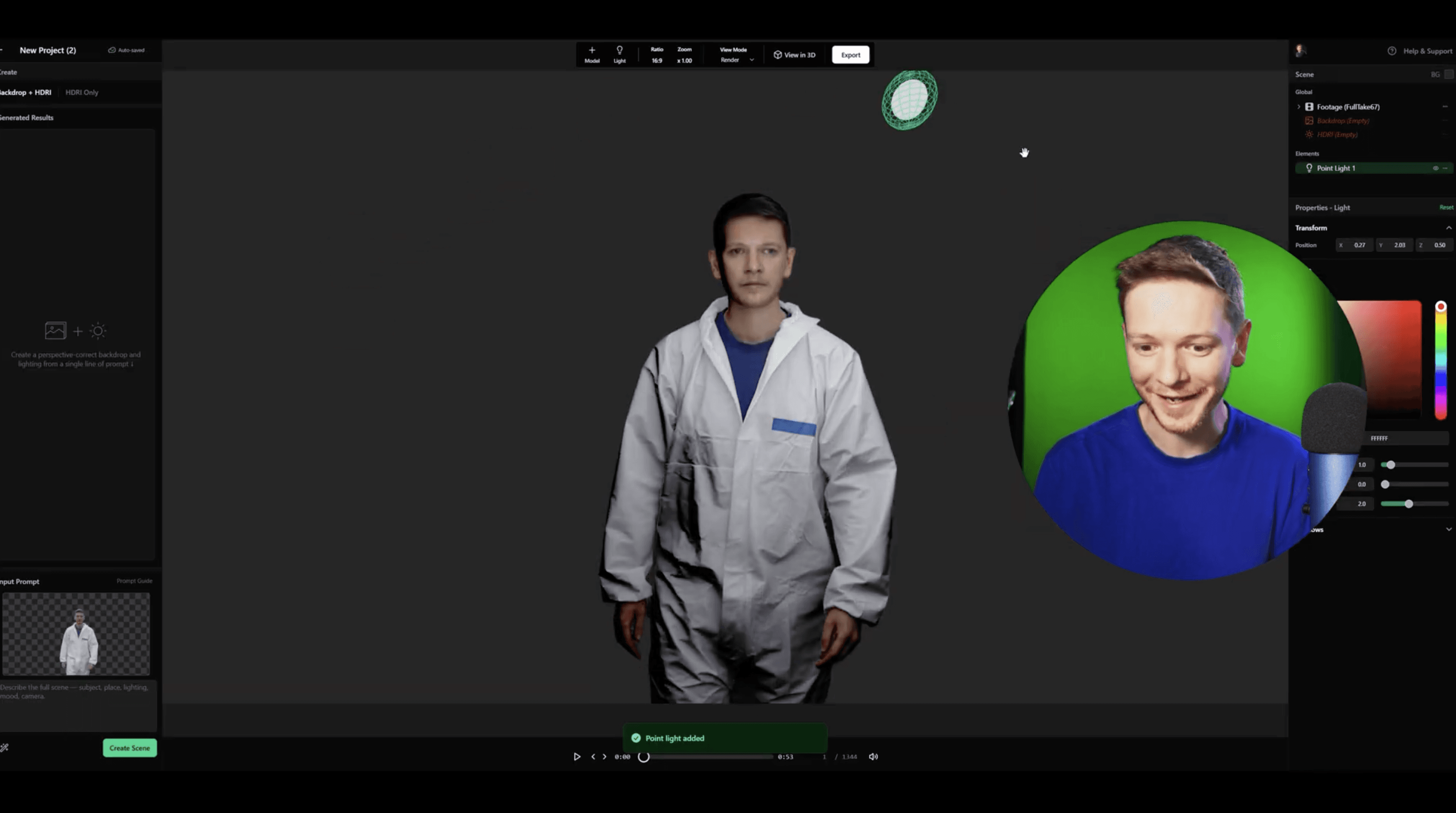
Then someone mentioned Beeble on Discord. I gave it a try and immediately realised the quality was way ahead of anything else. At the time, it only produced two kinds of passes — one to even out the lighting and one to give a 3D normal map — but it worked in a way nothing else did.
Evolving Workflows
What improvements in relighting workflows have you noticed as the tools have developed?
It's evolved massively. Early on, integration into Unreal was completely manual — hours of work. Now it's almost one click.
The quality of the maps is also much higher, especially the normals. And instead of two passes, you've got six different types, which makes the lighting feel much more realistic. It has evolved from a proof-of-concept to a production-ready solution in just a couple of years. It's been a nice thing to have been on that journey with them as they progress and improve.
You recently set yourself a 24-hour challenge — what did that experiment show you about working faster with these tools?
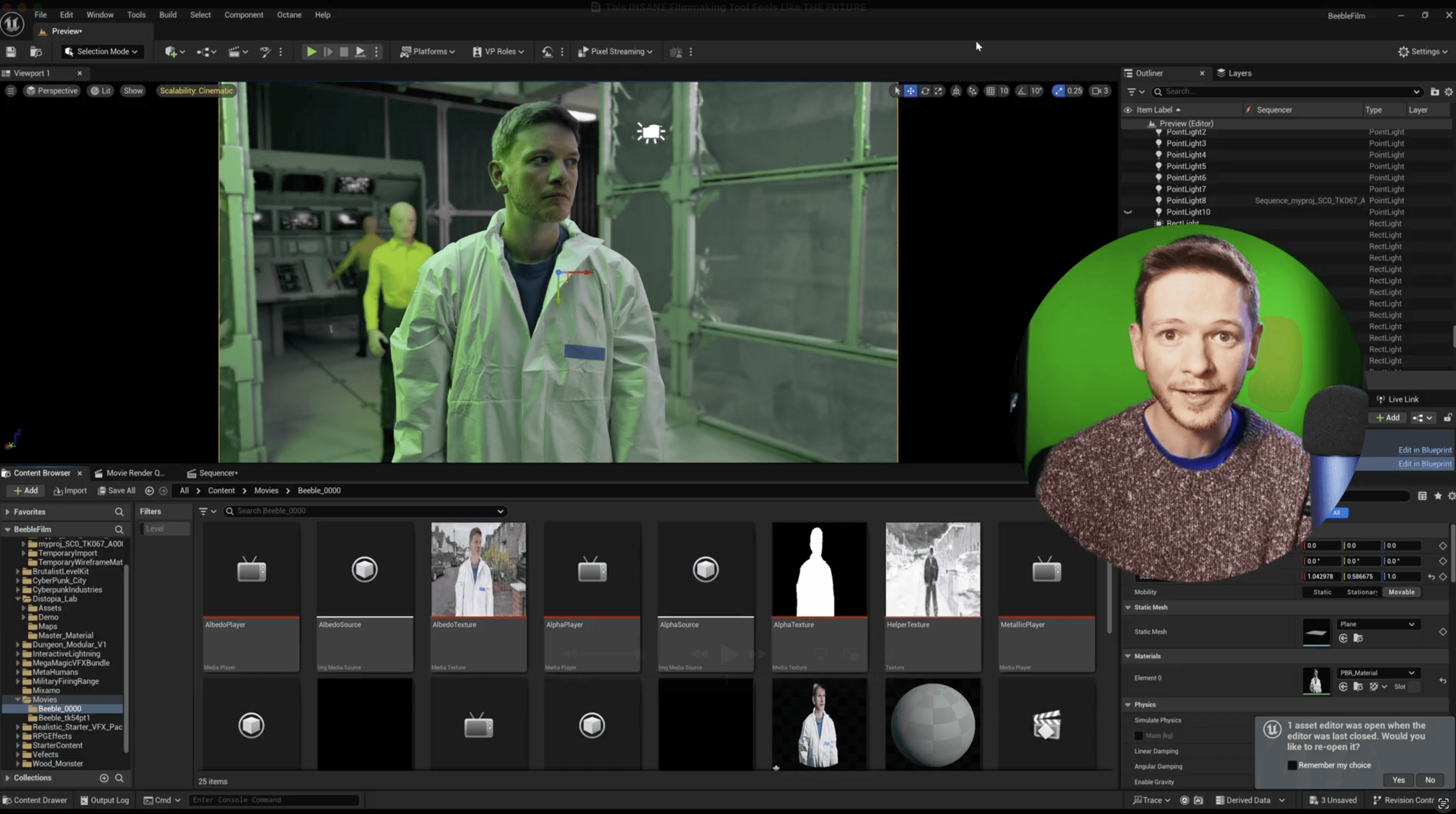
That came from a dare, really. Hoon Kim, Beeble's CEO, suggested I try making something in 24 hours. I don't think he expected me actually to do it — but I came back the next day with a short that worked.
What would have taken me days now takes hours, and the results still look cinematic. That's the kind of breakthrough that makes independent creators sit up and think: okay, this is possible.
Consistency Matters
From your perspective, what separates a useful AI tool from one that isn't production-ready?
Most generative tools are chaotic — you can't control them, you can't iterate, and they don't fit into production pipelines. Generative can't do what Beeble does, because it will change the way your character looks. Other AI systems I've tested can perform relighting, but often alter the appearance of a character. That's not acceptable. Consistency matters. Beeble manages it, and my money's on them for getting there first.
Beeble generates something familiar, useful, and completely production-ready. Any VFX artist can look at it and say: yes, this makes sense. It fills a gap that would otherwise be a very manual and difficult job.
Looking ahead, how do you see relighting fitting into your future projects and experiments?
I like to run small individual tests — relighting, green screen, different workflows — and then pull everything together into a bigger project. Beeble is going to be a central part of that.
I've also seen some of what Hoon is working on next, and I can't wait for it to be released.
Conclusion
For Joshua M Kerr, AI relighting isn't just about saving time; it's about unlocking creative freedom. By removing the need for complex dual-lighting setups and speeding up iteration, Beeble's SwitchLight makes it possible for creators to achieve cinematic results from anywhere, on any budget.
Whether you're experimenting at home or pushing the boundaries of professional VFX, tools like Beeble are proving that relighting can be faster, more consistent, and accessible to everyone. Try it yourself in 3D Relight — AI relighting in a real-time browser 3D scene.