How Makaco used SwitchX and Nuke to deliver photoreal VFX at record speed
"Beeble is allowing our artists to focus much more on the creative side of the work instead of spending so much time on technically complicated green screen workflows."

Makaco is a Peru-based VFX and post-production studio led by Diego Velásquez. Known for its photorealistic visual effects work across film and advertising, the studio specializes in environment replacement, set extensions, character animation, and complex compositing workflows.
With over 15 years of experience working in Nuke, Diego and his team have increasingly explored how AI tools can integrate into high-end production pipelines — not as a replacement for traditional VFX, but as a way to expand creative possibilities, accelerate delivery, and rethink how modern compositing teams operate.
Tell us about the recent TV commercial you worked on — over 30 green screen shots is no small task. What was the brief?
We had a very important project: the relaunch of Peru's most important beer for the international market. We needed a world-class look and had to recreate locations from Paris, London, and New York, as well as scenes from ancient Peru. The director wanted complete freedom to move the camera with a very handheld, dynamic style.
We were also working against a very tight deadline of two and a half weeks. Recreating all the environments and keying the characters traditionally would have been extremely difficult within that timeline.
We started experimenting with SwitchX. I filmed myself at home without a green screen and placed myself into locations like Sydney and Brooklyn to demonstrate the relighting, tracking, and keying capabilities. Once the director saw the results, he was sold on the workflow.
Using SwitchX even allowed us to make quick tests on set, which helped us choose the correct camera angles and movements during production.
How did you approach replacing environments and relighting those shots using SwitchX?
First, we created concepts for the backgrounds using AI tools before filming. That way, we already knew how we wanted each shot to look, and we could light the set and position the camera accordingly. But even with careful planning, the lighting on set rarely matched the concepts perfectly. That's where the relighting capabilities of SwitchX became extremely useful.
One of the biggest breakthroughs during the project came when we discovered that we could feed the original concept art directly into SwitchX — even if the character in the image wasn't the same person — and it would recreate the lighting and overall mood almost perfectly.
Once we figured that out, the workflow became much faster and more flexible. We were able to move quickly through the remaining shots while still maintaining a very high-quality result. We then combined the SwitchX output back with the original plates in Nuke to recover the full color range, especially for skin tones, while giving the DP complete control over the final grading process.
The client especially praised the camera movement, background tracking, and the quality of the keying — particularly how much hair detail we were able to preserve. Since then, some of our other work has also been featured on Beeble's Instagram page, including a personal project I had wanted to make for almost five years. Thanks to SwitchX, I'm finally close to finishing it in my free time.
You said you completed it in "record time" — how does that compare to a more traditional Nuke pipeline?
That first commercial was completed in about two weeks. Using only traditional tools, the budget would probably have been three or four times larger because we would have needed to recreate, track, and project all the backgrounds in 3D.
In terms of timing, it likely would have taken around two months. Even with that schedule, I'm not sure we could have achieved the same results.
Since then, we've continued using SwitchX more and more. Just last week, we finished another spot shot entirely on green screen in only five days after filming, with results that people genuinely believed were shot on location.
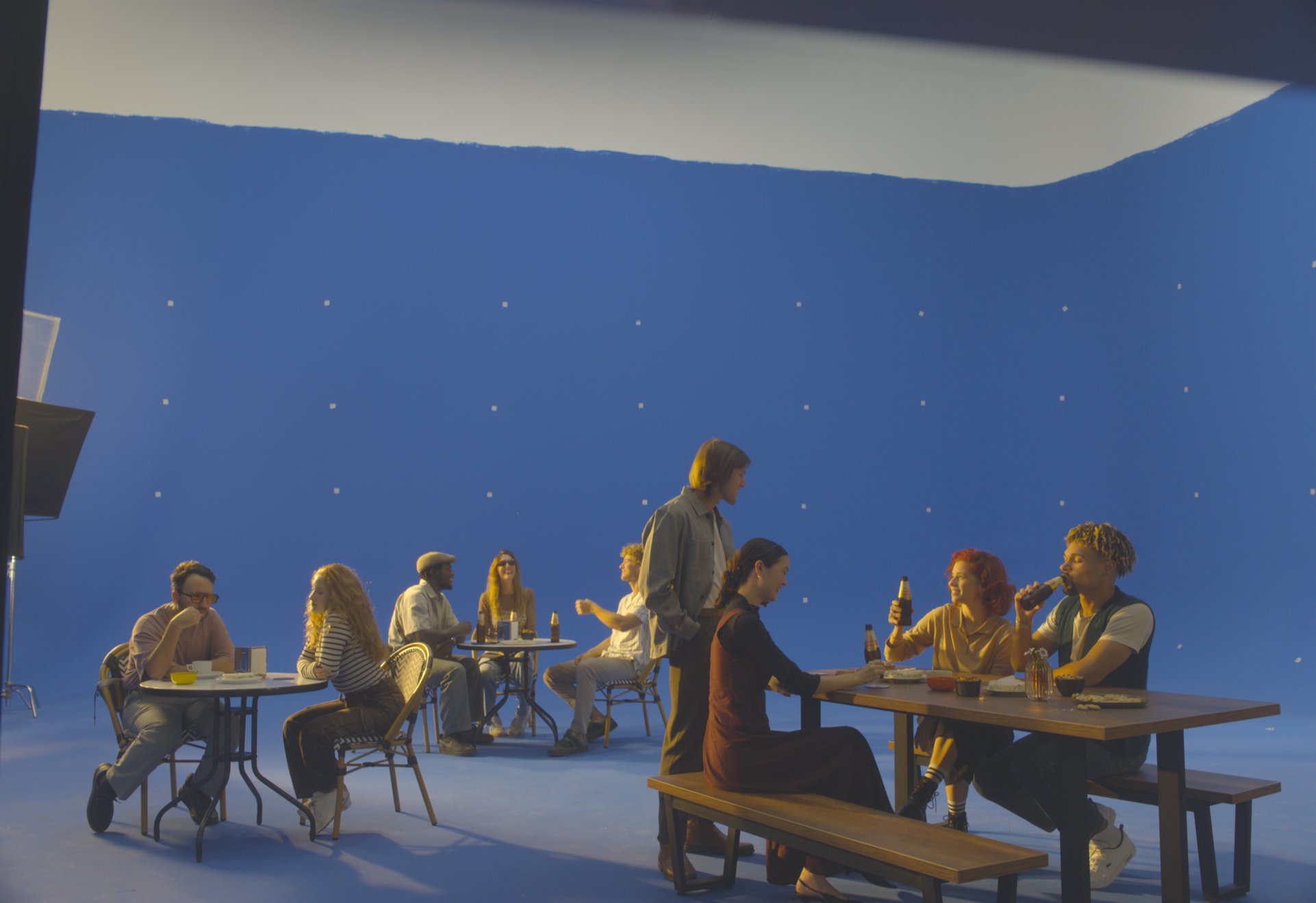 Green screen plate
 Relit with SwitchX
Any other projects you'd like to mention?
Yes — we recently completed another project for the largest bank in Peru in an extremely short timeframe.
We shot everything on green screen and delivered photorealistic results in only five days. We filmed on Wednesday, had the offline ready by Thursday, and delivered the final commercial on Tuesday.
Interestingly, all the client feedback focused on acting and continuity between shots — not on the environments or compositing — almost as if they forgot it had been shot on green screen.
When did you first come across Beeble, and what made you start using it in production?
Actually, one of the artists in the office first discovered it while looking for alternatives for rotoscoping. As we started using it, we quickly realized how powerful it was for generating normal passes as well.
It soon became our everyday tool of choice for roto and relighting. Once SwitchX came out, we kept finding more and more ways to integrate it into our pipeline.
You mentioned you're now using Beeble SwitchX every day — why has it become part of your core workflow?
Mainly the speed and ease of use. Like with most new tools, we first experimented with it on personal artistic projects. That helped us understand both its strengths and its limitations. We realized that many of those limitations could be solved by combining the results back with the original plates inside Nuke.
Once we finished our internal tests, we started using it on professional work. The results have been amazing both in terms of output quality and turnaround speed.
You've been working with Nuke and AI for a while — what drew you into combining those two worlds?
Nuke has been the foundation of our pipeline for around 15 years. Over the last two or three years, we started experimenting more seriously with AI — initially as a way to create short films faster and at a lower cost.
As the technology evolved, we realized it could also replace or enhance parts of our traditional workflows, like face animation or set extensions. Since then, we've been combining the two approaches more and more.
Has this experience changed how you think about your pipeline or the role of your team?
Completely. Now we approach every project with the question: "Can we do this with SwitchX or AI?" That mindset is influencing how we plan pipeline updates and even how we structure the studio moving forward.
Beeble is allowing our artists to focus much more on the creative side of the work instead of spending so much time on technically complicated green screen workflows.
How do you balance AI automation with creative control and precision in your work?
AI is affecting our work in almost every department now. Our art direction team uses it daily, not only for concept art, but also for asset creation and even final shots. Our compositors can focus more on creative iterations rather than repetitive roto and keying tasks.
At the same time, our AI department continues to grow each month. Just last week, for example, we completed another commercial mixing fully AI-generated shots with SwitchX footage, using video recorded remotely by a celebrity in Spain while we directed the shoot over Zoom.
Ready to explore the workflow yourself?
Try SwitchX and explore how studios like Makaco are combining AI and traditional compositing workflows to accelerate production without sacrificing creative control.