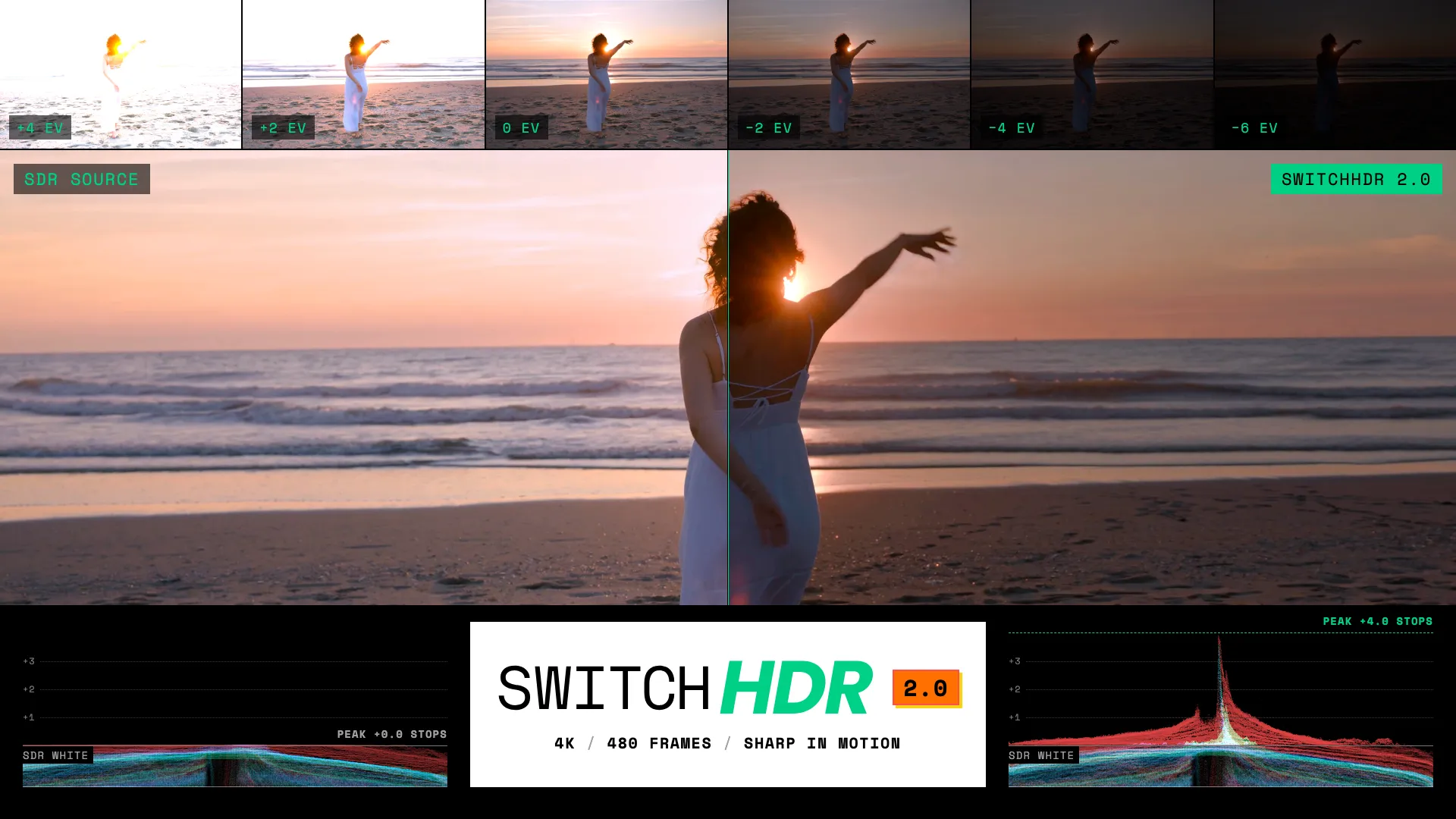
Introducing SwitchHDR 2.0
SwitchHDR is our model for true HDR recovery: it rebuilds 16-bit scene radiance from ordinary 8-bit SDR footage, so blown highlights and crushed shadows hold up in the grade.
SwitchHDR 2.0 is a new architecture, built on the techniques behind SwitchX 2.0 and adapted for HDR recovery, with a result that stays locked to your source.
What's new in 2.0
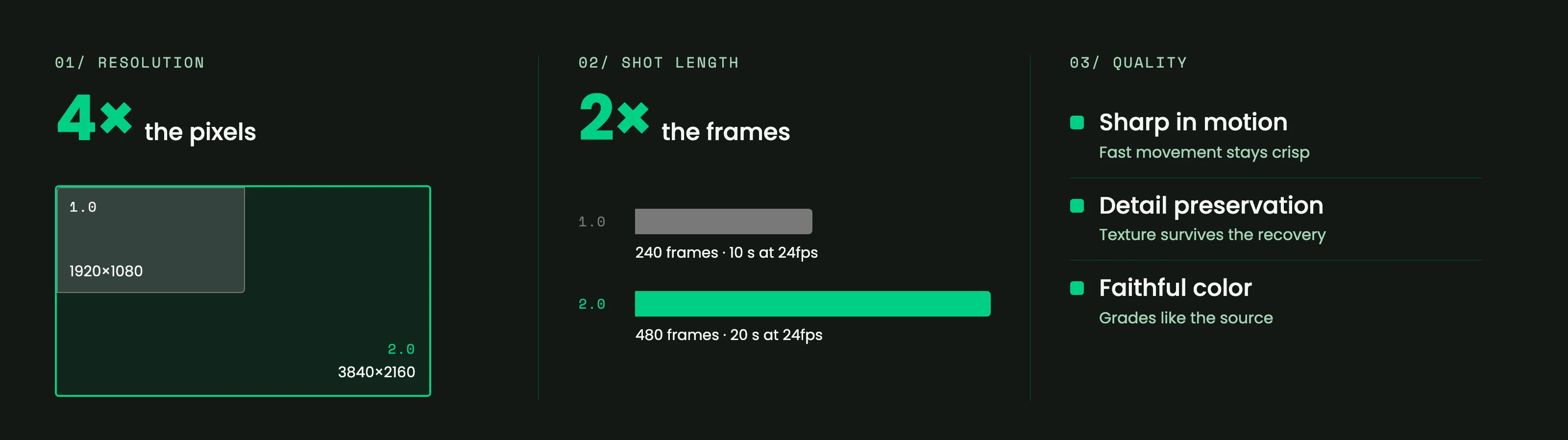
- Native 4K output, at 3840×2160.
- Up to 480 frames, 20 seconds at 24fps, in a single job.
- Sharp in motion, even when the movement is fast and busy.
- Detail held from the source, so the texture of your footage survives the recovery.
- More faithful color, so the HDR result grades like the source it came from.
4K & 480 frames
SwitchHDR 2.0 renders natively in 4K, and one job covers up to 480 frames: 20 seconds at 24fps. The model reads the full-resolution source while it recovers, so fine structure comes from your footage, not from an upscaler.
Sharp in motion
Fast movement comes through crisp, without smearing or ghosting. Try it on the shots that move: dance, sports and handheld footage.
Detail preservation
Recovery should only add what the SDR signal lost. SwitchHDR 2.0 keeps everything else as it was: fine texture, small text, motion blur. The output stays pixel-aligned with your source, so you can layer it over the original in the composite, and nothing drifts.
Faithful color
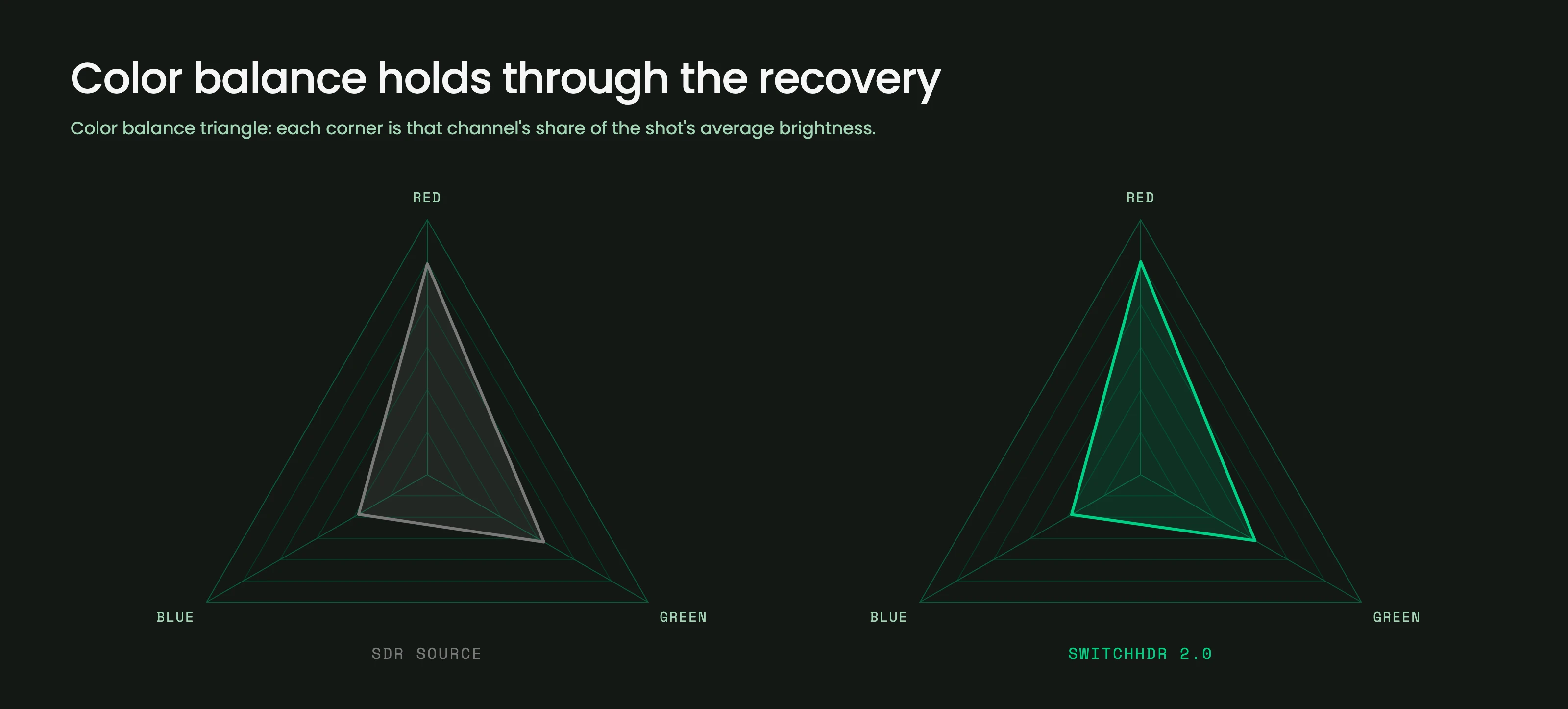
SwitchHDR 2.0 adds range without drifting your color. The red, green and blue channels keep the same balance as the source, so the shot drops into the grade you already had, without a correction pass.
Ready for your pipeline
Choose the output color space when you generate: ACES2065-1 (AP0), ACEScg (AP1), or linear Rec.709. Every video render also comes with an HLG MOV, so you can review and share the result on any HDR display.
Everything from 1.0 carries over
Highlight and shadow thresholds still decide where the model recovers and where it leaves your footage alone: outside the mask, the source is kept pixel for pixel.
Put SwitchHDR 2.0 to work
SwitchHDR 2.0 is available to everyone in the Beeble cloud app, on the SDR to HDR page and as a node in the canvas. 4K output is part of the Professional plan.