Keeping performance real while rebuilding the world: The hybrid workflow behind Crooks
"Technology can make the world larger without making the performance smaller."
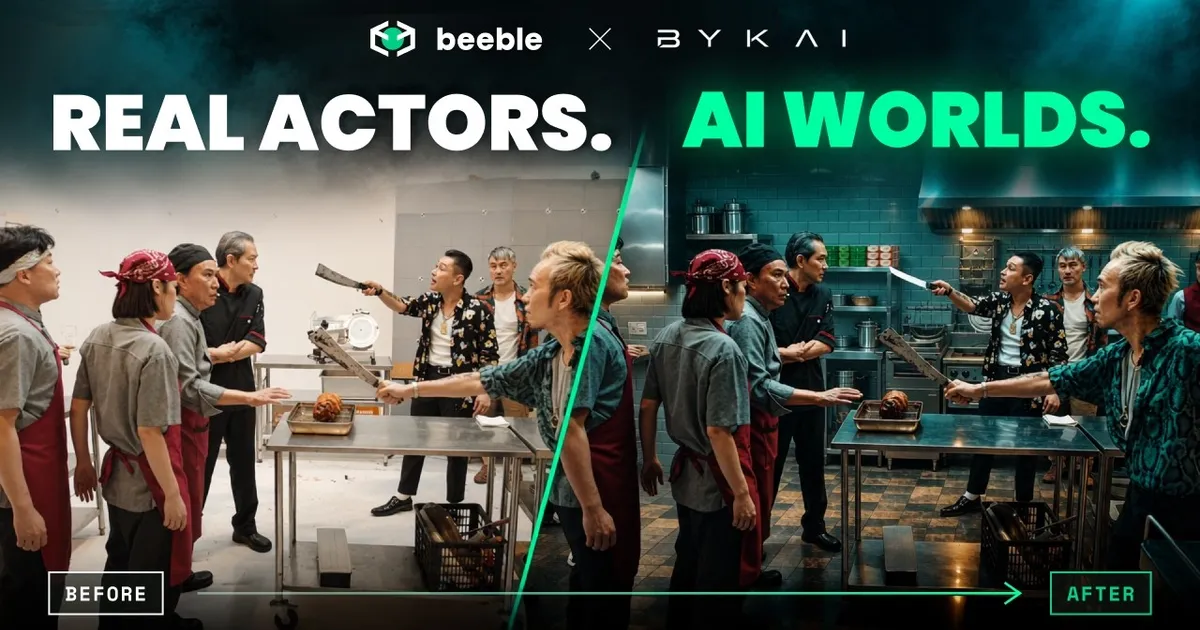
For Crooks, the ambition was never to make an AI-generated drama. It was to find a way to make a live-action production whose world could extend far beyond what its budget and schedule would traditionally allow.
Produced by B-01 Films, with BYKAI developing and integrating the AI-hybrid workflow, Crooks brings together traditional filmmaking expertise and new production techniques. B-01 Films provides the production foundation; BYKAI contributes the planning, R&D and workflow integration that connect live-action capture with digitally constructed environments.
Developed as a nine-part premium series, Crooks moves through historically specific locations and environments, while keeping real actors, performances and cinematography at the centre of the production. For the first episode alone, the team needed to capture 22 different locations across an eight-day shoot.
To make that possible, showrunner Boi Kwong of B-01 Films, who is also CEO of BYKAI, and Lim Kim Hui, Chief AI Strategist at BYKAI, developed a hybrid production model that combined live-action filmmaking with 3D environments, AI, and VFX techniques. The team separated the process into three layers: capture the performance first, build the world around it, then bring everything together in the finish.
BYKAI's contribution was to connect these layers into a production infrastructure, making decisions about what to capture practically, what could be built digitally, and how to preserve continuity through the finished sequence. That expertise is central to its proposition for producers and studios considering AI-hybrid production.
The team integrated Beeble into the workflow, giving the filmmakers greater flexibility to work with the original photographed performance while adapting the lighting and environments around it.
Crooks also provides a case study for BYKAI's international ambitions: applying production expertise developed in Singapore to projects with overseas producers, directors and studios.
We spoke with Boi and Kim about the creative ambition behind Crooks, why performance became the non-negotiable part of their workflow, and how changing what could happen after the shoot influenced what was possible on set.
Could you introduce yourselves, your roles on Crooks, and how you became involved in the project?
Boi: I'm Boi Kwong, founder of B-01 Films, the production company behind Crooks, and CEO of BYKAI. I come from a traditional filmmaking background, and I'm the showrunner on Crooks. I was actually very sceptical about AI at the beginning. I'm fiercely protective of actors and authentic performance, and I didn't want technology taking over the creative part of filmmaking.
But Crooks was an ambitious project, and we reached a point where our budget wasn't enough to realise the vision in the traditional way. I hit a wall and started looking for different ways to move the project forward. That's when I met Kim. He started showing me what some of these tools could actually do. What changed my perspective was realising that we weren't talking about replacing actors or replacing filmmaking. We could preserve the performance and use technology to make more of the world around it possible.
Kim: I'm Lim Kim Hui, Chief AI Strategist at BYKAI, and my background is much more on the technology side. Boi and I came into this from very different perspectives, so we spent a lot of time in pre-production doing R&D and testing what could actually work reliably enough for production.
You describe Crooks as a "character-led premium series where the world can grow as quickly as the story demands." What was the creative ambition behind it?
Boi: Crooks is rooted in a real story and takes us into an earlier period of Singapore, so the world needed to feel historically believable.
We had to create environments including a prison, a hospital, a two-storey restaurant, and historically accurate buildings and locations that either no longer exist or would be very difficult to find and control for a shoot today.
The scale was huge for the schedule we had. Episode one alone involved 22 locations across eight shooting days.
But I didn't want those constraints to make the world of the story smaller. The question became: how do we keep the performances and the filmmaking real while giving ourselves much more freedom over the environment around them?
You've said that "technology should make the world larger without making the performance feel smaller." How did that philosophy shape the production?
Boi: The performance was always the most important thing. Actors needed to perform together and have something physical to interact with. Green-screen acting isn't something every actor here is used to, so wherever interaction mattered, we used practical props, markers and physical elements to give them a sense of the space around them.
I also didn't want to restrict the camera. We shot handheld. We used dynamic camera movement. For me, the technology had to adapt to the filmmaking. I didn't want the filmmaking adapting to the limitations of the technology.
What were the main production or VFX challenges you needed to solve to make that possible?
Kim: One of the biggest challenges was consistency. It's possible to generate a very convincing individual image, but filmmaking is about sequences. The camera moves, you change perspective, you cut to another angle, and the world and performance still need to feel like they belong to the same scene.
With generative tools, if you give the model too much freedom, it can start changing things you don't want changed. It might change the environment, but it can also start changing the composition, camera perspective or the character.
So we couldn't treat a shot as one image that we handed over to AI. We needed to separate the elements and define what could be altered and what needed to remain untouched.
Where did Beeble fit into the workflow?
Kim: Beeble became an important part of the process of bringing the photographed performance and the world together.
We worked closely with the Beeble team during R&D and production, particularly on how we could use the technology to relight and integrate the live-action material into different environments.
For us, the key was starting from the original performance. The actor's movement and expressions were already there, and camera choices were already there. We didn't want those things to be regenerated.
Beeble gave us another level of control over what we could change around that source material.
Boi: Beeble saved our lives. I didn't want to sacrifice the actors' performances or change the way I wanted to shoot just to make the technology work.
What did Beeble allow you to do differently?
Boi: One of the biggest areas was lighting.
We could capture the actors under more controlled, relatively flat lighting rather than needing to commit to every aspect of the final look while we were shooting.
That gave us much more flexibility afterwards. We weren't always dependent on the natural light being perfect or waiting for something like golden hour. We could focus on getting the actors and the performance right, knowing we had more control over the lighting later.
That becomes very important when you're working on a schedule like ours.
Could you describe a sequence where Beeble played an important role?
Boi: We had scenes shot in the studio that needed to become very dark, atmospheric night environments.
If we'd shot the actors under the final lighting we wanted for those scenes, we would have committed to that look very early and potentially limited what we could do with the footage afterwards.
Instead, we could capture the performance with the information we needed and then use Beeble to relight the actors for the finished environment.
What mattered was that the performance didn't change. We still had the actor's face, expressions and movement, and we still had our original camera work. We were changing the conditions around that performance.
Did flexibility in post affect production decisions?
Boi: Definitely. When you know you have that flexibility later, you start making different decisions on set. Lighting is one example, but it also affects locations and how much of an environment physically needs to exist when you're shooting. That meant we could focus our time on what had to happen in front of the camera.
At the same time, we didn't want that freedom to become an excuse to fix everything later. If something was important to the actor's performance or physical interaction, we still wanted it there on set.
That's the hybrid part of the workflow. You're constantly deciding what needs to be real and what can become flexible.
How did you choose between AI practical filmmaking and traditional VFX?
Boi: We never wanted to use AI just because we could.
Performance remained real. Physical interaction remained important. Then we looked at the environment around that and asked where technology could give us more freedom.
Kim: It's not really AI versus VFX. Different parts of the image need different tools.
We worked alongside established VFX processes throughout the production. The question was always: what gives us the control we need for this particular shot?
AI becomes another part of that pipeline, rather than replacing it.
Has Crooks changed how you think about future productions?
Boi: I'm opening the drawer again. I've put away projects because I knew what they would cost to make. Some ideas were too big to realise with the resources available. Now I'm looking at those projects again.
That's what has changed for me. It's not about removing actors, crews or filmmaking from the process. It's being able to look at a story that previously felt impossible and ask whether there is now another way to make it.
Technology can make the world larger without making the performance smaller.
What could this mean for BYKAI and overseas productions?
Boi: Crooks gives us a practical case study to discuss with other filmmakers. Through BYKAI, we want to work with producers and studios internationally to explore whether this approach can help realise their stories. We would start with their script and creative goals, identify scenes that suit a hybrid approach, and test a defined sequence before discussing a larger production.
Kim: Every project needs its own assessment. We would look at what must be captured on set, which environments can be developed digitally, and how the work will fit the existing production and post-production teams. The aim is to make our experience useful to another production while keeping creative decisions with the filmmakers.